EVERWOOD / WORLDWIDE PROJECTS
Global Logistics & Reverse Engineering Services
You do not need to ship your entire vehicle to EVERWOOD. Our unique reverse-engineering process allows you to send only the damaged wooden part, a 3D CAD file, or an original technical blueprint directly to our workshop in Poland. We reconstruct the part and ship the finished component back to you, anywhere in the world.
Start Your Project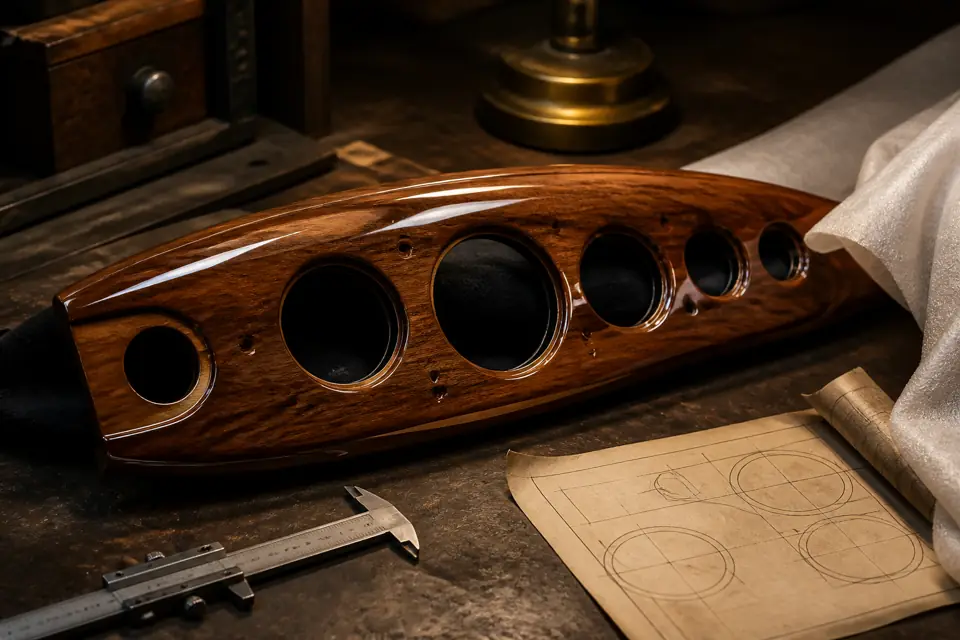
The EVERWOOD Restoration Workflow
STEP 01
Send
Share the part, blueprint or digital file.
STEP 02
Scan
Capture the original geometry and references.
STEP 03
Engineer
Develop and review the CAD model.
STEP 04
Craft
Mill, veneer or form and finish the component.
STEP 05
Deliver
Arrange protected return shipping.
START A PROJECT
Send your blueprint or sample details
Tell us about your vehicle, the part and its condition. Our workshop can discuss the next steps before you send an original component.
Workshop:
ul. Pułaskiego 9B
08-110 Siedlce, Poland
A Step-by-Step Guide to Our Global Reverse Engineering Process
1. Digitalization & 3D Scanning
If you only have a damaged, cracked, or partially missing part, we can still help. You can ship the original remains to us. Our engineers use high-precision 3D scanners to create a digital point cloud of the object. If the part is entirely missing, we can work directly from original factory blueprints or CAD files, meticulously recreating the geometry to match the vehicle's exact specifications.
2. Engineering & CNC Milling
Once the CAD model is finalized, we mill the core structure. For interior trims (dashboards, consoles), we use high-strength ABS/PC polymers that resist cabin heat and UV. For structural frames (roof bows, chassis subframes), we select seasoned European Ash wood (Jesion) and utilize traditional steam-bending techniques. This ensures the wood fibers remain intact and retain their structural integrity.
3. Veneering & High-Gloss Finishing
For interior components, we apply authentic veneers (Burr Walnut, Zebrano, Vavona) using vacuum-pressing technology to ensure a seamless bond without air pockets. The piece is then sealed with multiple layers of 2K polyurethane clear coat, hand-sanded and polished to a piano finish. This provides a deep, mirror-like gloss that protects the wood from the elements.
4. Safe Global Shipping & Customs
We understand that shipping fragile, high-value car parts internationally can be stressful. All finished parts are wrapped in soft protective materials and packed in reinforced, custom-built wooden crates. We ship worldwide using trusted couriers (DHL, FedEx). Please note: For shipments outside the European Union (e.g., to the USA, UK, or Asia), any applicable customs duties and import VAT are the responsibility of the buyer. We provide all necessary commercial invoices and HS codes to ensure a smooth customs clearance process.
Preparing your first inquiry
A good project brief connects the part to the vehicle and explains the result you want. Include the marque, model, year, body style and steering-wheel position, along with the name and location of the component. Tell us whether the goal is to restore an original piece, replace one missing panel or discuss a wider structural project. If the component has been modified before, describe those changes as well.
Photographs of the visible surface, edges, rear side and mounting points can help communicate damage and geometry. Where possible, include a scale or dimensions and take an additional photograph showing the part in relation to the surrounding interior or body. These references do not need to replace a technical drawing; they provide useful context for the first conversation. The workshop can then advise what further information is needed.
Working from a part, blueprint or CAD file
A damaged part may retain the shape, fixing positions or joint details needed to understand its original function. Handle fragile remains carefully and document their orientation before disassembly. If a piece is broken into several sections, keep the fragments together and explain how they relate to one another. Avoid repairing or trimming the reference part solely for shipping without first discussing the intended approach with the workshop.
A drawing or digital model can be helpful when a physical sample is not available. Include relevant dimensions and identify the units, viewing orientation and any known changes from the original configuration. The upload form accepts one PDF, STL, STEP, STP, JPG or JPEG file up to 8 MB. If you have several files or a larger archive, describe them in your message and ask the workshop how to transfer them securely.
Before sending an original component
- Contact the workshop first. Confirm the scope and obtain instructions for the part you intend to send.
- Document its condition. Photograph all sides, damage and mounting points before packing.
- Protect individual pieces. Keep fragile fragments and fittings from moving against one another during transit.
- Include your details. Identify your name and project so the package can be matched to the inquiry.
- Arrange the shipment. Confirm the destination, carrier requirements and relevant customs documentation for your route.
Do not send the entire vehicle unless a separate arrangement has been agreed. For particularly fragile or unusually large pieces, ask about suitable protection and transportation before booking a courier. The appropriate package depends on the dimensions, condition and construction of the part, and the sender should check the carrier's own restrictions and insurance conditions.
Coordinating a restoration across borders
International projects involve more than the physical journey of a parcel. Owners and restoration professionals should consider the information required by the carrier, the receiving workshop and customs authorities. The description of a part, its purpose and its documented value can be relevant to shipment paperwork. Requirements vary by country and by whether the item is being sent for repair or returned after work, so confirm the applicable procedure with your carrier or customs adviser.
For customers outside the European Union, import VAT, duties and other charges can affect the total landed cost. These are separate from an agreed workshop price or delivery quote unless explicitly stated otherwise. Clearance times also vary by destination and documentation. Discuss your deadline early, especially if the component must be installed alongside upholstery, electrical work or other stages of a larger restoration.
Review, finish and installation
A restoration project can involve choices about material, surface finish, fit and the treatment of adjacent original components. Provide reference photographs of the surrounding trim if the new piece needs to complement an existing interior. Because natural veneer varies in figure and color, discuss your priorities rather than relying on the appearance of a single screen image.
After delivery, inspect the package and component before installation, and retain the packaging until you are satisfied with its condition. A professional restorer can advise on the correct sequence for fitting the part and protecting nearby upholstery or painted surfaces. For structural framework work, coordinate installation with qualified vehicle restoration specialists and provide the workshop with any questions about the reference information used for the project.
Privacy and file handling
Only send documents that you are authorized to share. Remove unrelated personal or commercially sensitive information from photographs and drawings where practical. Depending on the configured delivery service, uploaded files may be sent as email attachments or stored by a third-party upload provider. When that provider is enabled, the form displays its file-link visibility notice. Contact the workshop first if your project requires a different method for sharing confidential plans.
The form supports a single optional attachment; a detailed written description is still useful when no file is available. If sending fails, contact the workshop directly rather than assuming the message was received. Keep a copy of your project description and any reference material so that questions about the component can be resolved throughout the restoration process.
COMMON QUESTIONS
Frequently Asked Questions
Do I need to ship the whole car?
No. Contact the workshop to arrange sending the damaged part, a blueprint or a CAD file.
Who pays customs duties and import VAT?
For shipments outside the European Union, any applicable customs duties and import VAT are the responsibility of the buyer.
Which file types can I submit?
You can attach one PDF, STL, STEP, STP, JPG or JPEG file up to 8 MB to your inquiry.
Where should I send my part?
Arrange delivery with the workshop first, then send your part to EVERWOOD, ul. Pułaskiego 9B, 08-110 Siedlce, Poland.